What to Actually Record in a Trading Journal
Most journals collect data nobody ever reads. Here are the fields that change behaviour.
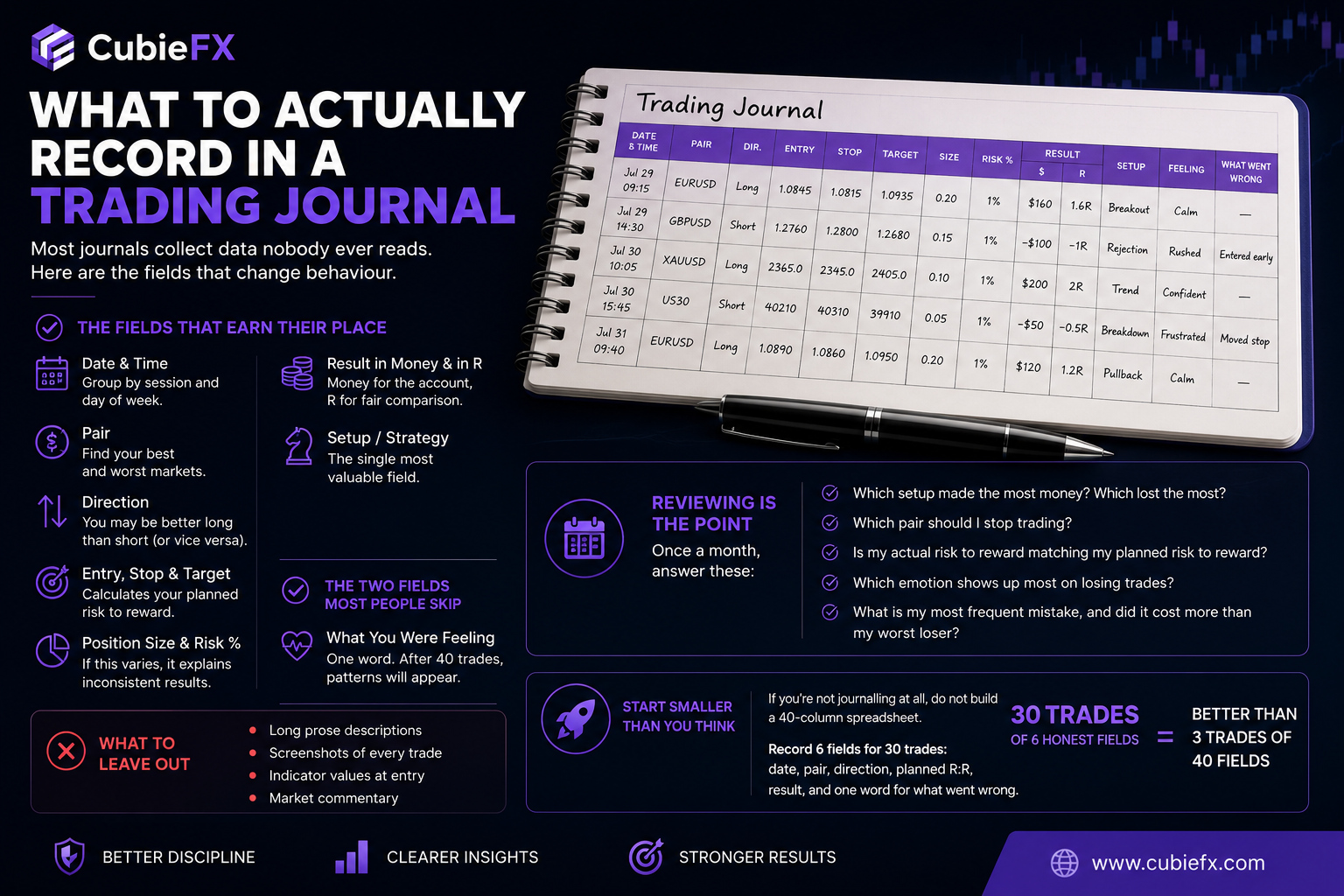
Almost every trader starts a journal. Almost none of them are still using it three months later. The reason is nearly always the same: they recorded things they never went back and read.
The test for any field
Before adding a column, ask: what question will this let me answer?
"Entry price" answers nothing on its own. "Session" answers "am I better in London or New York?" — which is a question you might actually act on.
The fields that earn their place
Date and time. Not for the record, but so you can group by session and by day of week.
Pair. Almost everyone is meaningfully better on some instruments than others, and almost nobody knows which until they count.
Direction. Many traders are substantially better long than short, or the reverse. It usually surprises them.
Entry, stop and target. These give you planned risk to reward, which is the number you compare against what actually happened.
Position size and risk percentage. If this varies when it should not, that alone explains a lot of inconsistent results.
Result in money and in R. Money for the account, R for comparing trades of different sizes fairly.
Setup or strategy name. The single most valuable field. Without it you cannot tell which of your methods works.
The two fields most people skip
What you were feeling. Not a diary entry — one word. Calm, rushed, frustrated, bored, confident. After forty trades you will find that one of those words is attached to most of your worst results. That is actionable in a way no indicator is.
What went wrong, if anything. Also one phrase: entered early, moved stop, oversized, revenge trade, no setup. This is the field that turns a journal from a record into a tool.
What to leave out
- Long prose descriptions. You will not read them
- Screenshots of every trade. Keep them for the unusual ones
- Indicator values at entry. Interesting once, useless in aggregate
- Market commentary. That is a different document
Reviewing is the point
A journal you never review is a chore with no payoff. Once a month, sit down and answer these:
- Which setup made the most money? Which lost the most?
- Which pair should I stop trading?
- Is my actual risk to reward matching my planned risk to reward?
- Which emotion shows up most on losing trades?
- What is my most frequent mistake, and did it cost more than my worst loser?
Five questions. Twenty minutes. That review is worth more than the logging itself.
Traders who journal without reviewing are collecting evidence for a trial that never happens.
Start smaller than you think
If you are not journalling at all, do not build a forty-column spreadsheet. Record six fields for thirty trades: date, pair, direction, planned R:R, result, and one word for what went wrong.
Thirty trades of six honest fields beats three trades of forty fields, every time.
Not financial advice. This article is educational. Trading carries substantial risk and you can lose more than your deposit. See our risk disclaimer.
Size your next trade properly in under ten seconds.
Open Lot Size Calculator