Revenge Trading: What It Actually Is and How to Stop It
The trade after the loss is where most accounts are lost. Here is what to do about it.
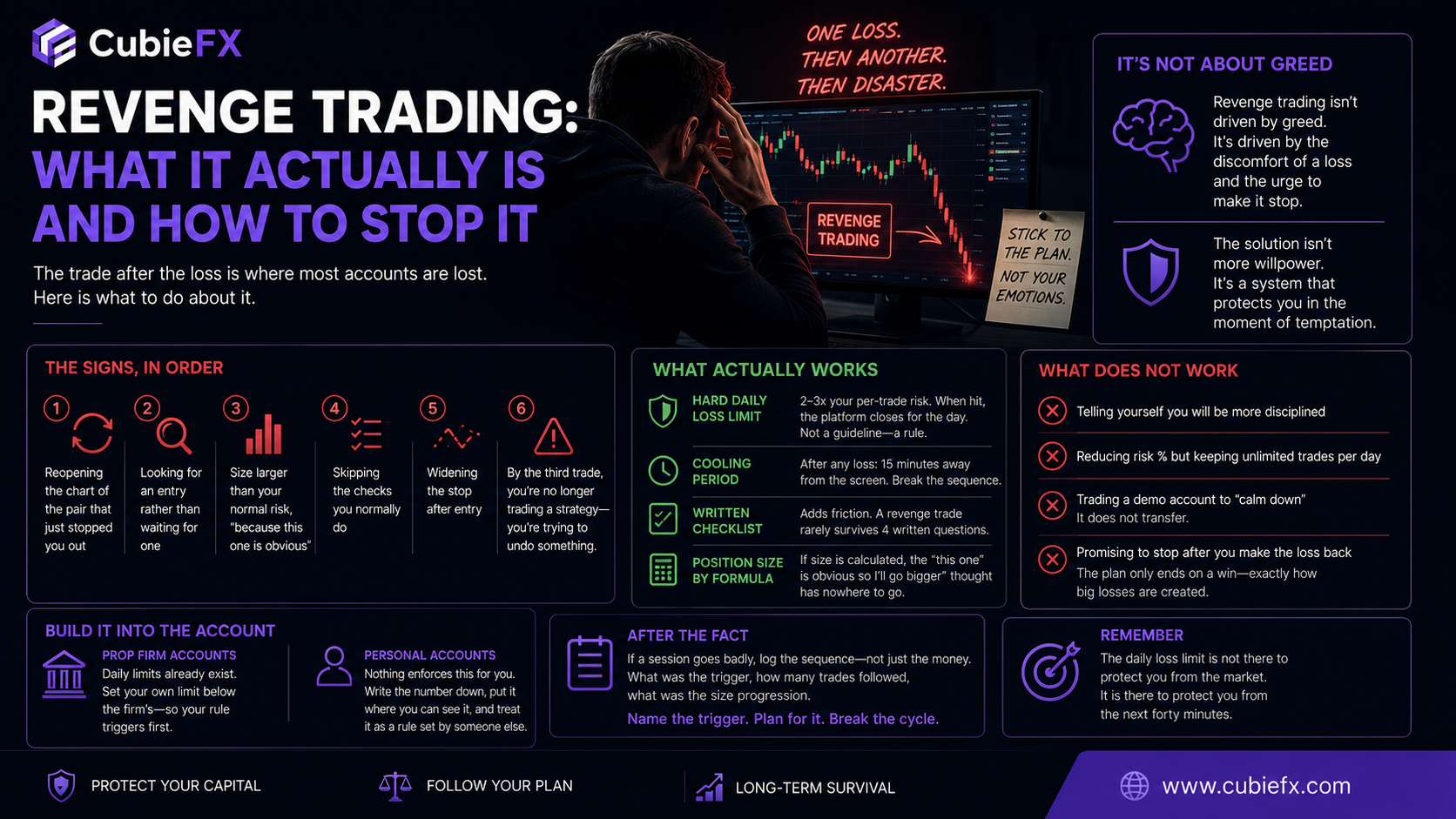
Almost every large single-day loss follows the same shape. A loss, then a bigger trade to make it back, then a much bigger one. By the third trade, the person is no longer trading a strategy — they are trying to undo something.
It is not about greed
Revenge trading is usually described as a discipline problem, as though the solution is simply to want it less. That framing is not much use, because the thing driving it is not greed. It is the discomfort of an open loss and the urge to make that discomfort stop.
Understanding that changes the fix. You do not need more willpower at the moment of temptation. You need a system that makes the moment of temptation less decisive.
The signs, in order
- Reopening the chart of the pair that just stopped you out
- Looking for an entry rather than waiting for one
- Size larger than your normal risk, "because this one is obvious"
- Skipping the checks you normally do
- Widening the stop after entry
Most traders can recognise steps 4 and 5 afterwards. The intervention has to happen at step 1 or 2.
What actually works
A hard daily loss limit. Two or three times your per-trade risk. When it is hit, the platform closes for the day. Not a guideline — a rule with no exceptions, decided when you are calm.
A cooling period after any loss. Fifteen minutes, away from the screen. Short enough to be realistic, long enough to break the sequence.
A written entry checklist. Not to improve entries — to add friction. A revenge trade rarely survives contact with four written questions.
Position size fixed by formula. If size is calculated rather than chosen, the "this one is obvious so I'll go bigger" thought has nowhere to go.
What does not work
- Telling yourself you will be more disciplined
- Reducing your risk percentage but keeping unlimited trades per day
- Trading a demo account to "calm down" — it does not transfer
- Promising to stop after you make the loss back
That last one deserves attention, because it is the most common. The plan "I will stop once I am flat" means the session only ends on a win, which is precisely the condition that produces the largest losses.
The daily loss limit is not there to protect you from the market. It is there to protect you from the next forty minutes.
Build it into the account
If you trade a prop firm account, the daily limit already exists and breaching it ends the account. That is a useful structure. Set your own limit *below* the firm's, so your rule triggers first.
On a personal account, nothing enforces this for you. Write the number down, put it where you can see it, and treat it as though someone else set it.
After the fact
If a session goes badly, log it honestly. Not the money — the sequence. What was the trigger, how many trades followed, what was the size progression.
Traders who log revenge sequences almost always find the same trigger appearing repeatedly. Once you can name it, you can plan for it. Until then, it will keep happening and keep feeling like it came out of nowhere.
Not financial advice. This article is educational. Trading carries substantial risk and you can lose more than your deposit. See our risk disclaimer.
Size your next trade properly in under ten seconds.
Open Lot Size Calculator