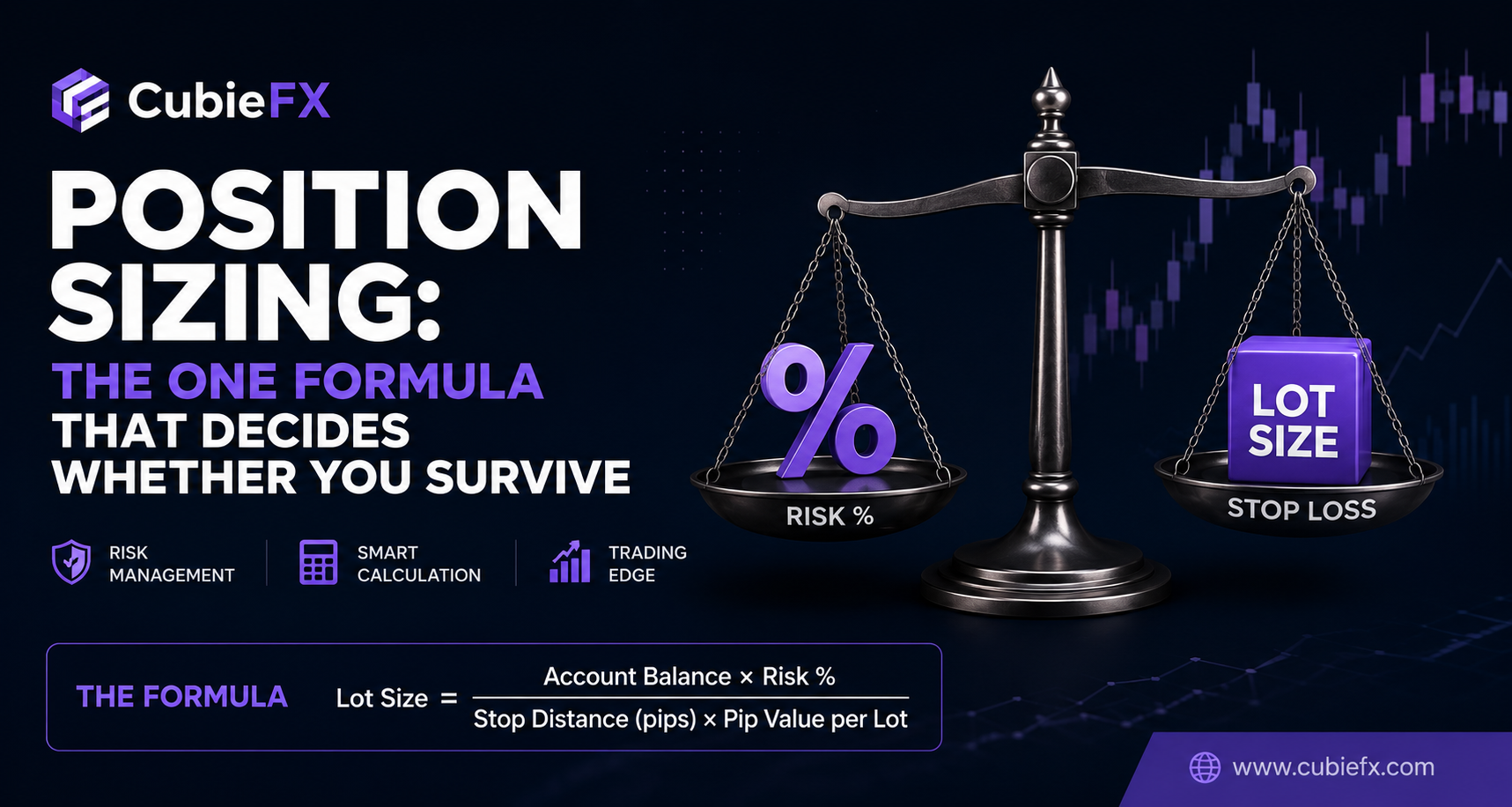
Position Sizing: The One Formula That Decides Whether You Survive
Most traders size a position by feel. Here is the arithmetic that replaces the guess.
Ask ten traders how they chose their lot size on the last trade and most will say some version of "it felt about right". That is the single most expensive habit in retail trading, and it is also the easiest one to fix.
The order of operations is backwards for most people
The usual sequence is: pick a lot size, enter, then put a stop somewhere that looks sensible. That produces a different loss on every trade. One costs $40, the next costs $380, and there is no way to tell whether the strategy works because the results are noise.
The professional sequence is the reverse:
- Decide what this trade is allowed to cost you
- Put the stop where the idea is proven wrong
- Let those two numbers calculate the size
Size is an output, not an input. Once you accept that, most sizing problems disappear.
The formula
Risk Amount = Account Balance × Risk Percentage
Lot Size = Risk Amount ÷ (Stop Distance in Pips × Pip Value per Lot)
On a $10,000 account risking 1% with a 50 pip stop on EUR/USD: the risk amount is $100, pip value is $10 per standard lot, so 100 ÷ (50 × 10) = 0.20 lots.
Widen the stop to 100 pips and the size halves to 0.10 lots. The planned loss has not changed. That is the whole point.
Gold is not a currency pair
The formula holds, but the contract size does not. One standard lot of XAU/USD controls 100 ounces, so a $1 move is worth $100 per lot. A trader who applies forex arithmetic to gold ends up roughly ten times too large, which is one of the most common ways a prop firm account dies in a single session.
Check the contract size for whatever you trade:
- Standard forex pair: 100,000 units
- Gold: 100 ounces
- Silver: 5,000 ounces
- Most index CFDs: 1 unit per point
How much per trade
- 0.5% to 1% while you are still building consistency, and on any prop firm challenge
- 1% to 2% once you have a tested edge and a live track record
- Above 2% is difficult to defend. At 3% per trade, seven losses in a row costs a fifth of the account
Seven losses in a row is not unusual. If your risk cannot absorb it calmly, it is too high.
Why fixed lot sizes fail
Trading 1.00 lots regardless of balance means your risk grows as a proportion of the account while the account shrinks. Lose 20% and your "same" position is now risking 25% more of what remains. Percentage-based sizing does the opposite: it shrinks automatically during a drawdown, which is exactly when you need it to.
Round down, always
If the formula gives 0.27 lots and your broker takes two decimals, take 0.27, not 0.30. Rounding up on every trade quietly lifts your risk above the figure you decided on, and it compounds.
The trader who sizes every position from a fixed percentage is running a measurable experiment. The trader who sizes by feel is running a different experiment every time and calling the results a strategy.
Where to start
Fix your risk percentage this week. One number, applied to every trade. Log the results and look again in a month — not at whether you made money, but at whether your losses are now the same size.
That consistency is what makes everything else measurable.
Not financial advice. This article is educational. Trading carries substantial risk and you can lose more than your deposit. See our risk disclaimer.
Size your next trade properly in under ten seconds.
Open Lot Size Calculator