Drawdown: Why Losses Hurt More Than Gains Help
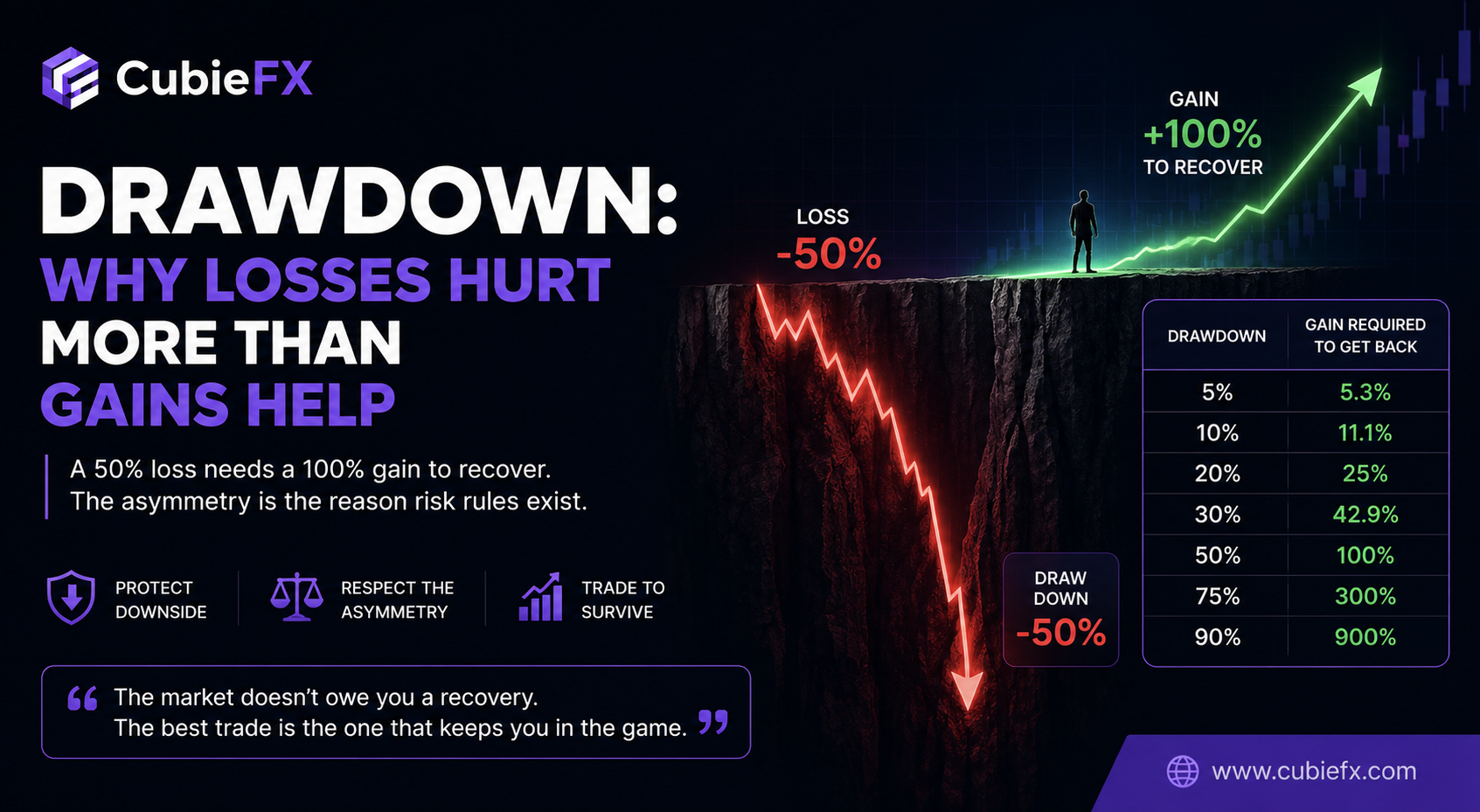
A 50% loss needs a 100% gain to recover. The asymmetry is the reason risk rules exist.
There is one piece of arithmetic that, once understood properly, changes how a trader thinks about risk permanently. It is not complicated. It is just deeply unfair.
The recovery table
| Drawdown | Gain required to get back |
|---|---|
| 5% | 5.3% |
| 10% | 11.1% |
| 20% | 25% |
| 30% | 42.9% |
| 50% | 100% |
| 75% | 300% |
| 90% | 900% |
Losses and gains are not symmetrical. Lose half the account and you need to double what is left just to return to where you started.
Why this happens
Each percentage is taken from a smaller base. A 10% loss on $10,000 costs $1,000, leaving $9,000. A 10% gain on $9,000 returns only $900. You are behind by $100 despite equal percentages.
The gap widens as the drawdown deepens, which is why the table accelerates so sharply at the bottom.
What this means in practice
Protecting the downside matters more than chasing the upside. A method that makes 40% a year with a 10% maximum drawdown will beat one that makes 80% with a 45% drawdown over any meaningful period — and it will be survivable psychologically, which the second one will not.
Big single losses are disproportionately expensive. One 20% day requires 25% to recover, which at 1% risk per trade and a 50% win rate is a long grind. It is not "one bad day". It is often a bad quarter.
Reduce size in a drawdown, not after a winning run. Most traders do the opposite. They size up when confident and hold size when losing, which is exactly backwards given the arithmetic.
The prop firm version
This is why funded accounts have hard drawdown limits, and why the trailing versions are so much harsher than they look. A 10% trailing drawdown does not give you 10% of room. It gives you 10% from your highest point, which shrinks the moment you make money.
Traders who read that rule as "I can lose 10%" have misread it.
The market does not owe you a recovery. The only reliable protection is not being in the hole in the first place.
A practical drawdown plan
Decide these before you need them:
- At 5% down: review the last ten trades. Was the process followed?
- At 10% down: halve position size until you have made half of it back
- At 15% down: stop for a week. Not as punishment — because a drawdown of that size usually means either the market changed or you did, and neither is diagnosed while trading
Write these down before the drawdown. Nobody makes good decisions about this at 15% down.
The number that actually predicts survival
Not win rate. Not annual return. Maximum drawdown — because it is the only figure that tells you whether the account, and the person trading it, can still be there next year.
Not financial advice. This article is educational. Trading carries substantial risk and you can lose more than your deposit. See our risk disclaimer.
Size your next trade properly in under ten seconds.
Open Lot Size Calculator