Choosing a Forex Broker: What Matters and What Is Marketing
Spreads get the attention. Regulation, execution and withdrawal reliability matter more.
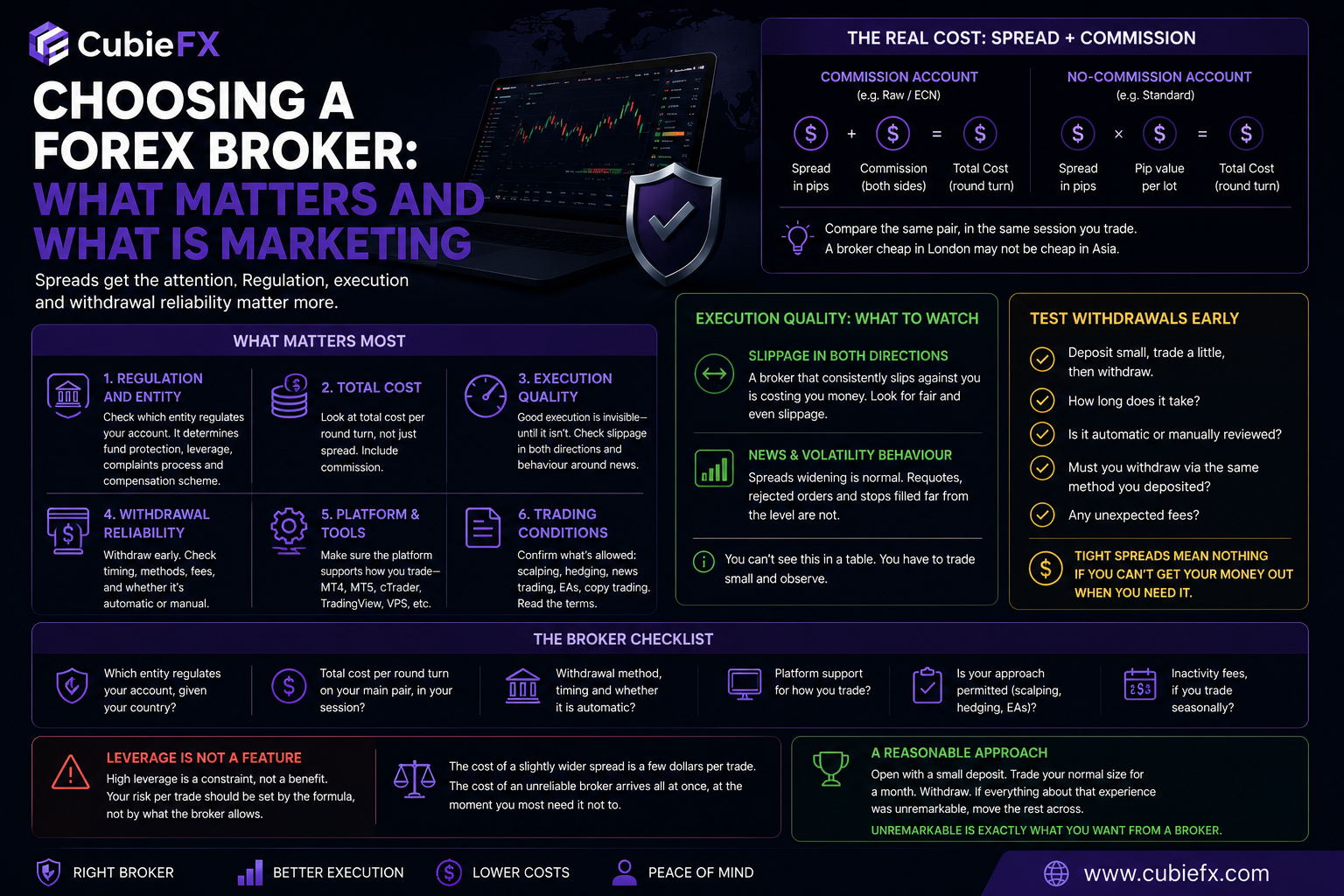
Broker comparison pages tend to rank on spread, because spread is a single number that is easy to put in a table. It is a real cost, but it is rarely the thing that decides whether an account works out.
Regulation, and specifically which entity
Most large brokers operate several entities. The same brand might have one regulated in a strict jurisdiction and another in a much lighter one, and which one you sign up under depends on the country you register from.
This determines things that matter a great deal if something goes wrong: whether client funds are segregated, whether there is a compensation scheme, what leverage you are allowed, and whether you have anywhere to complain.
Check which entity your account will sit under before depositing. The information is usually in the client agreement rather than the marketing page.
The real cost is spread plus commission
A "zero commission" account is not free. The cost is inside the spread. A "0.0 pip" account charges commission.
To compare properly, convert everything to cost per standard lot round turn:
- Commission account: (spread in pips × pip value) + commission both sides
- No-commission account: spread in pips × pip value
Then compare the same pair, at the same time of day, on the session you actually trade. A broker that is cheapest during London can be mid-table during the Asian session.
Execution quality is invisible until it is not
Two things to look for:
Slippage in both directions. A broker whose slippage is consistently against you is worth leaving, regardless of spread. Some publish execution statistics; most do not.
Behaviour around news. Spreads widening during high-impact releases is normal. Requotes, rejected orders and stops filled far from the level are not.
You cannot assess this from a comparison table. You assess it by trading small for a month and watching.
Withdrawals are the thing to test early
Deposit small, trade a little, then withdraw. Do this in the first month, before you have meaningful money there.
What you want to know: how long it takes, whether it is automatic or manually reviewed, whether the method you deposited with is the one you must withdraw to, and whether anything unexpected appears at that point.
A broker with tight spreads and slow, awkward withdrawals is a bad broker.
Leverage is not a feature
High leverage is marketed as a benefit. It is a constraint on position size that you should mostly be ignoring anyway — your risk per trade should be set by the formula, not by what the broker will permit.
Very high leverage is worth noting mainly as a signal about which entity you are under, since strictly regulated jurisdictions cap it.
What to actually check
- Which entity regulates your account, given your country
- Total cost per round turn on your main pair, in your session
- Withdrawal method, timing and whether it is automatic
- Platform support for how you trade — MT4, MT5, cTrader, TradingView
- Whether your approach is permitted: scalping, hedging, expert advisors
- Inactivity fees, if you trade seasonally
The cost of a slightly wider spread is a few dollars per trade. The cost of an unreliable broker arrives all at once, at the moment you most need it not to.
A reasonable approach
Open with a small deposit. Trade your normal size for a month. Withdraw. If everything about that experience was unremarkable, move the rest across.
Unremarkable is exactly what you want from a broker.
Not financial advice. This article is educational. Trading carries substantial risk and you can lose more than your deposit. See our risk disclaimer.
Size your next trade properly in under ten seconds.
Open Lot Size Calculator